
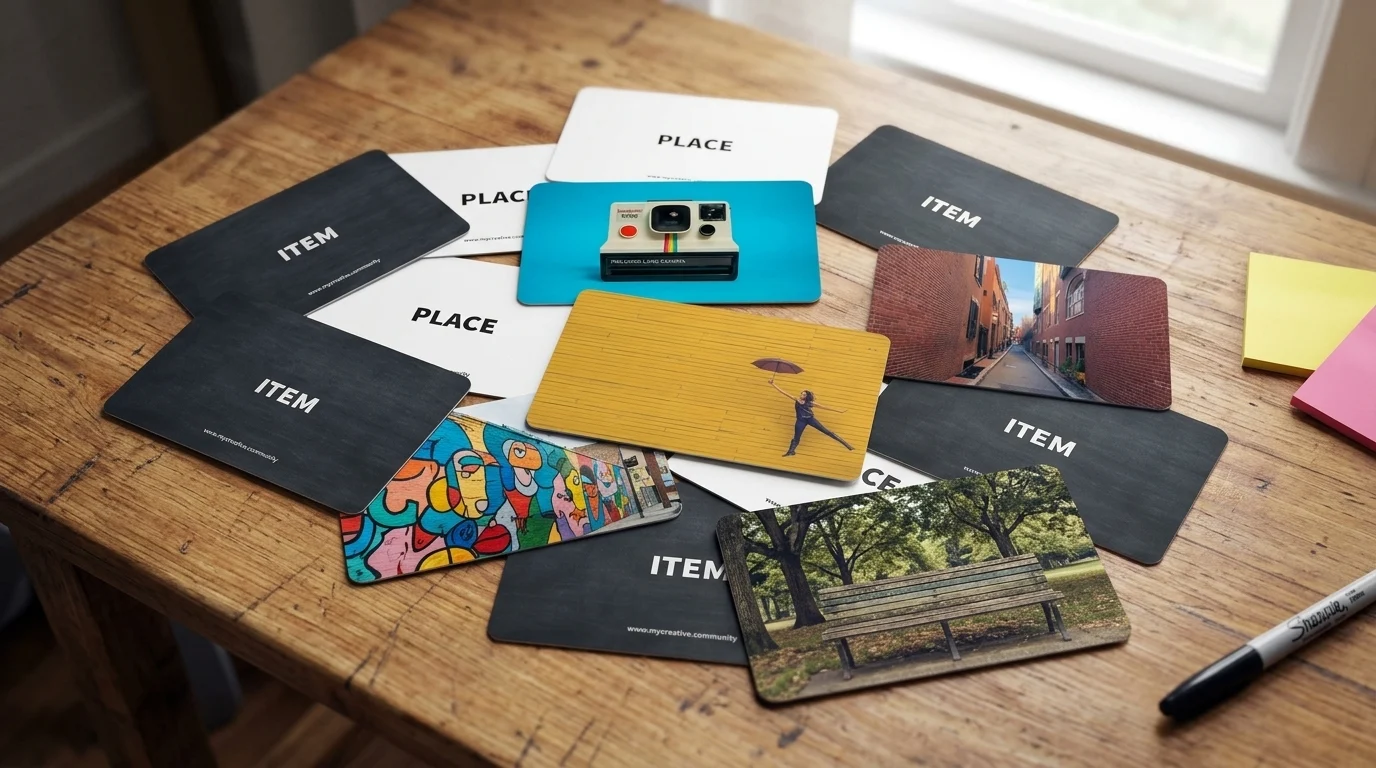
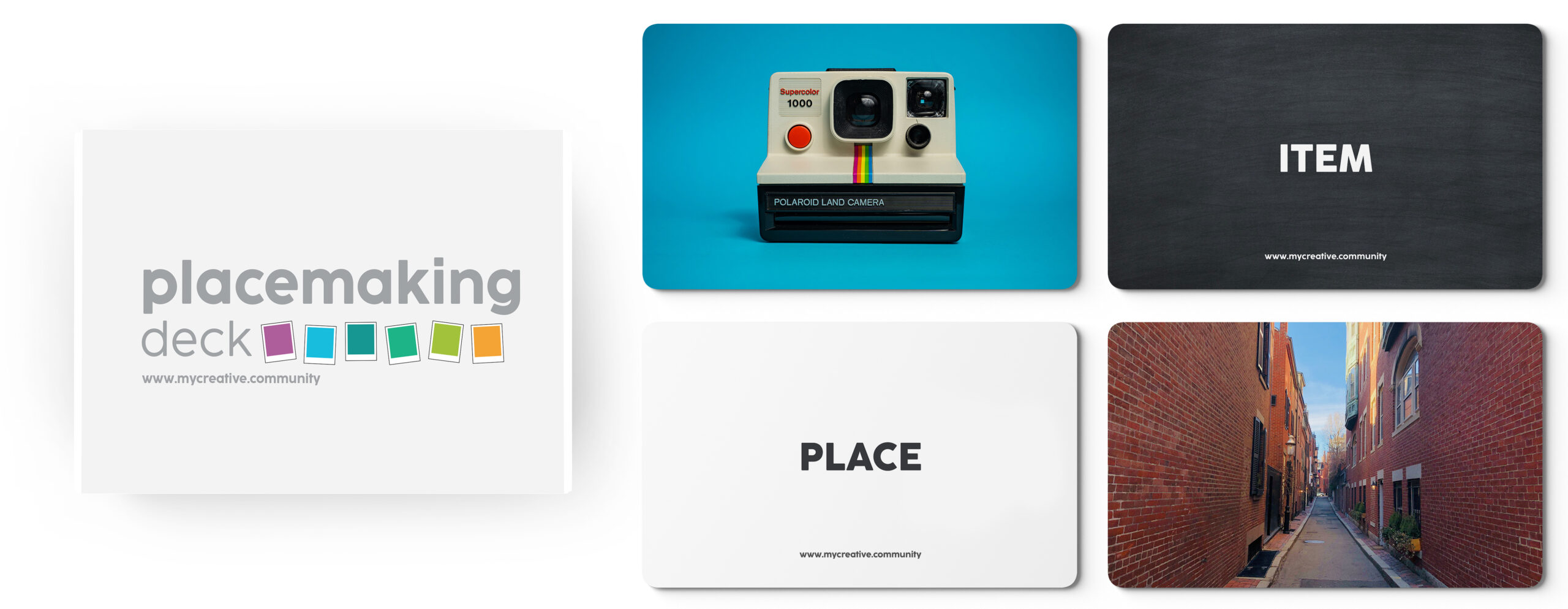
Placemaking is all about turning spaces into places that burst with local spirit and community life. Our Placemaking Card Deck, divided into 48 ITEM cards and 24 PLACE cards, is designed to spark creative new ideas and show where you could put those ideas into action.
When working with community members or colleagues, it can often be helpful to have a design tool that inspires creativity. Here are ten activities that leverage the Placemaking Card Deck as a tool to transform your community spaces.
1. Matchmaker
Time: 45 minutes | Best for: Kicking off a session and generating lots of ideas fast
Framing (5 min)
- Set the tone for rapid, creative brainstorming: quantity over quality. The goal is as many ideas as possible, as fast as possible.
Activity (25 min)
- Tape all PLACE cards on the walls around the room. Hand out ITEM cards and sticky notes.
- Each participant draws an ITEM card, finds a partner, and stands by a PLACE card.
- Pairs quickly brainstorm a placemaking idea that combines their items with that place and post it on a sticky note.
- Grab a new ITEM card, find a new partner, and repeat.
Debrief (15 min)
- Share the most unique or surprising ideas. Talk about how unexpected combinations can lead to innovative solutions.
2. Card Safari
Time: 60-90 minutes | Best for: Getting outside and seeing your own streets with fresh eyes
Framing (10 min)
- Explain that the best placemaking starts with noticing. Today the group walks the neighborhood and looks for the places hiding in plain sight.
Activity (45-60 min)
- Give each small group a handful of PLACE cards and a stack of ITEM cards.
- Walk a set route. When a group spots a real location that matches one of their PLACE cards (an alley, an empty lot, a bus stop), they stop.
- They draw two ITEM cards and imagine what that spot could become. Snap a photo and jot the idea down.
Debrief (15-20 min)
- Back inside, groups share their photos and ideas. Map where ideas clustered and which spots surprised people.
3. Mash-Up Pitch
Time: 45 minutes | Best for: Energizing a group and building quick team creativity
Framing (5 min)
- Frame it like a game show: every team gets a random mix of cards and has to turn it into a project people would actually love.
Activity (30 min)
- Each team draws three ITEM cards and one PLACE card.
- Teams have 15 minutes to design a placemaking project that uses all four cards.
- Each team gives a 60-second pitch.
- Everyone gets three dot stickers to vote for their favorites.
Debrief (10 min)
- What made the winning ideas stick? What constraints helped creativity rather than limiting it?
4. Through Their Eyes
Time: 60 minutes | Best for: Designing for people who aren’t in the room
Framing (10 min)
- Remind the group that a great place works for lots of different people. Today you’re designing for someone specific.
Activity (35 min)
- Assign each small group a persona: a teenager, a retiree, a new resident, a small business owner, a family with young kids, etc.
- Each group picks one PLACE card and selects up to five ITEM cards that would draw their persona to that place.
- Groups write a short “day in the life” of their persona using the space.
Debrief (15 min)
- Compare designs. Where do personas overlap? Whose needs are we usually overlooking?
5. Worst Idea Ever
Time: 30 minutes | Best for: Breaking the ice and uncovering what really matters
Framing (5 min)
- Give the group permission to be ridiculous. This round is all about designing the worst possible place.
Activity (15 min)
- In pairs, draw a PLACE card and two ITEM cards.
- Design the most uninviting, awkward, or useless version of that space.
- Then flip it: what’s the opposite of each bad choice? Turn the worst idea into a great one.
Debrief (10 min)
- Share a few favorite “worst” ideas and their flips. What principles of good places showed up?
6. Map It Out
Time: 60 minutes | Best for: Seeing the big picture across a whole downtown or neighborhood
Framing (10 min)
- Bring out a large printed map of your community. Explain that the group will layer ideas onto real locations.
Activity (35 min)
- Participants place PLACE cards on the map where those kinds of spaces exist.
- Next, they add ITEM cards (or sticky notes inspired by them) to bring each spot to life.
- Step back and look for clusters, gaps, and natural connections between spaces.
Debrief (15 min)
- Where is energy already concentrated? Which areas are being left out? What could connect them?
7. Quick-Win Sort
Time: 45 minutes | Best for: Moving from a pile of ideas to a clear starting point
Framing (5 min)
- Introduce the idea of “lighter, quicker, cheaper” projects: small experiments that build momentum fast.
Activity (30 min)
- Use ideas from an earlier activity, or run a quick round of Matchmaker.
- Draw a 2×2 grid on the wall: impact (low to high) and effort (low to high).
- As a group, place each idea on the grid.
- Circle the high-impact, low-effort ideas. These are your quick wins.
Debrief (10 min)
- Pick one or two quick wins to pursue. Who’s excited to champion them?
8. Story Spark
Time: 45 minutes | Best for: Connecting people around what makes a place meaningful
Framing (5 min)
- Before designing new places, take a minute to reflect on the places that have meant something to us.
Activity (25 min)
- Spread all the cards face up. Each person picks an ITEM or PLACE card that reminds them of a favorite memory of a place.
- In pairs, share the story behind your card.
- Listeners write down the qualities that made that place special (a sense of safety, surprise, belonging, play).
Debrief (15 min)
- Harvest the qualities on a shared board. How might we design those qualities into the spaces we’re working on?
9. Build-a-Block Relay
Time: 60 minutes | Best for: Collaborative design across the whole group
Framing (5 min)
- Each table starts a design, and every other table helps build on it.
Activity (40 min)
- Give each table one PLACE card and a large sheet of paper. They sketch a starting idea using one ITEM card.
- Every 7 minutes, tables rotate to the next sheet, draw a new ITEM card, and add it to the existing design.
- Continue until each table returns to its original sheet.
Debrief (15 min)
- Each table shares how their design evolved. What did others add that you never would have thought of?
10. Prototype Plan
Time: 75 minutes | Best for: Turning your best idea into real action
Framing (10 min)
- Close the loop here. The goal is to walk out with a small, testable experiment you can run in the next 30 days.
Activity (45 min)
- Groups choose one idea from earlier in the session (a quick win is a great pick).
- Plan a 30-day pilot: Where will it happen? Who needs to be involved? What will it cost? What does success look like?
- Identify the first step each person will take this week.
Debrief (20 min)
- Each group shares their pilot plan. Invite commitments and offers of help from the room.
Put the deck to work
Mix and match these activities to fit your time and your group.
Want help designing a placemaking session for your community? We’d love to help. Let’s talk.